A SaaS Playbook to Get Cited in ChatGPT
Want to get cited in ChatGPT? Our guide shows SaaS teams how to optimize content for AI citations and drive organic visibility with language models.

To get your content cited in ChatGPT, it needs to be three things: discoverable, machine-readable, and authoritative. This means optimizing your site's technical guts so AI crawlers can find and understand your information. It also means building enough credibility that large language models (LLMs) see you as a trusted source. This is a new game, blending classic technical SEO with a smart content strategy.
Why Getting Cited by AI Is Your New Growth Channel
Are you looking for a fresh way to get in front of your target audience? Imagine your SaaS solution showing up directly in the answers millions of people get from tools like ChatGPT. This is a powerful new distribution channel that puts your brand in front of active buyers the moment they are researching a problem you can solve. This strategy has a name: LLM Optimization, or LLMO.
Let’s talk numbers. By December 2023, ChatGPT had 180 million users and was pulling in 1.6 billion monthly visits. With an estimated 37.5 million daily searches happening in 2024, it is obvious a huge amount of research now takes place inside these platforms. General research (37%) and commercial research (6%) are among the most common uses, which tells you that product teams are actively looking for solutions right now. You can learn more about these ChatGPT statistics and user trends.
This flow shows exactly how your content can become part of an AI-generated answer.
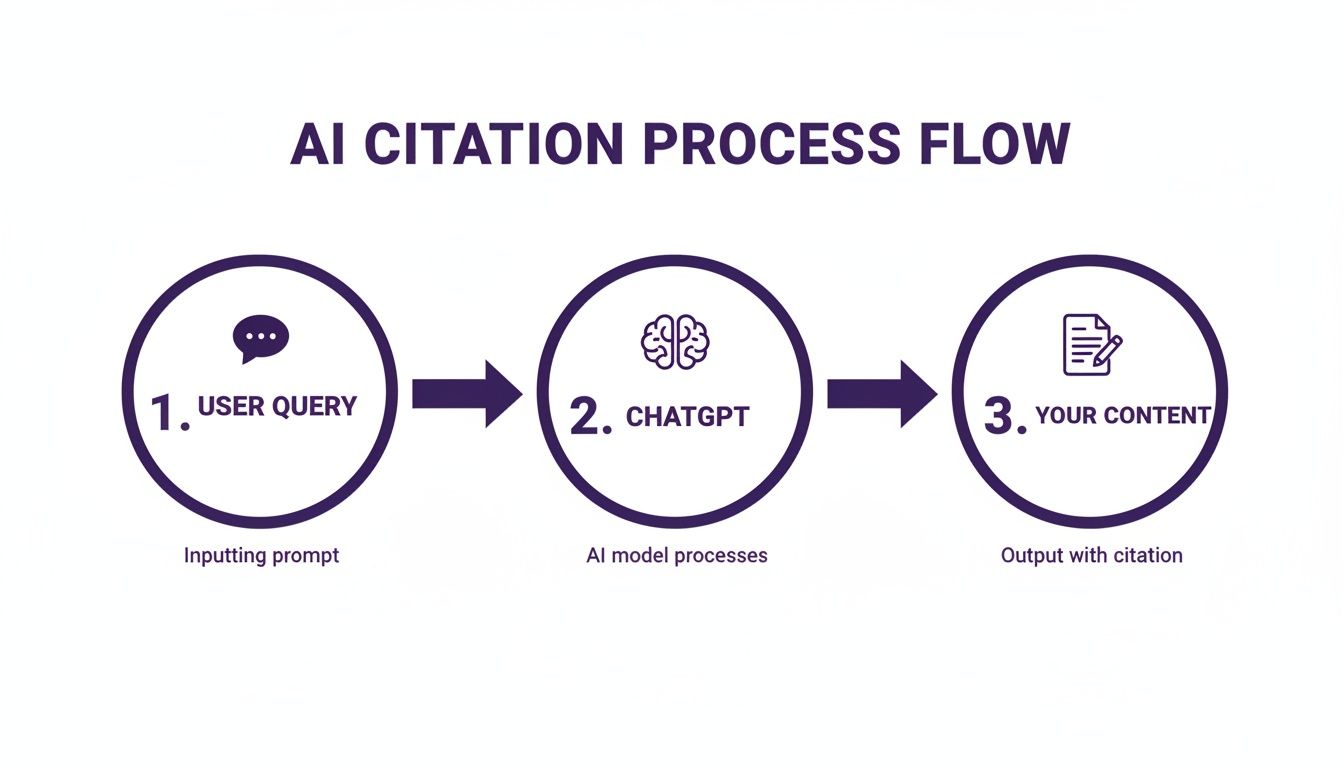
The journey is simple but powerful: a user asks a question, the AI processes it, and your content gets surfaced as a credible source in the answer.
The Business Case for LLM Optimization
For a SaaS company, the value here is incredibly direct.
When a product manager asks ChatGPT, "What are the best tools to reduce customer churn?" or "How can I collect user feedback effectively?" a citation for your brand is more than just a mention. It is a high-intent referral. The user is actively hunting for a solution. Being part of that answer immediately positions your product as a top contender.
This guide is your playbook to get cited in ChatGPT. We will walk through everything, from the technical groundwork to the content strategies that will make your brand a go-to source for AI.
LLM Optimization vs. Traditional SEO
While they share some DNA, optimizing for an LLM is a different beast than optimizing for Google. SEO is all about ranking a list of links for a user to click. LLMO is about getting your actual information synthesized into a direct answer.
The table below breaks down the key differences.
The fundamental shift is from "being found" to "being the source." With SEO, you want your link at the top. With LLMO, you want your data and your brand name embedded directly inside the AI's response.
For example, a traditional SEO play might target the keyword "customer feedback tools" with a long-form blog post comparing different options. An LLMO strategy would focus instead on creating highly structured content that clearly defines what your tool does, backed by data and case studies. This makes it dead simple for an AI to pull your product's name and features into a concise, authoritative answer.
Our goal with this guide is to give you actionable steps to make that happen. You will learn how to make your content discoverable, structure it for AI comprehension, and build the authority needed to become a trusted source. It’s all about turning AI into a reliable growth engine for your SaaS.
Getting Your Content on an AI's Radar
Before an AI like ChatGPT can ever dream of citing your content, it has to find it. Simple as that. Think of your website as a library. If your best books are hidden in a dusty, unmarked corner with no card in the catalog, no one is ever going to read them. AI crawlers are no different; you need to give them a clear map and an open door.
This all starts with the technical nuts and bolts of your site. The crawlers from places like OpenAI operate a lot like the bots from Google or Bing. They need clean, clear instructions on where they can go and what they can see. A well-structured website is your ticket to getting noticed in the first place.
Give AI a Clear Roadmap
Your sitemap is literally the blueprint of your website. It's what you hand to a crawler to say, "Hey, here are all the important pages you should look at." Without one, you're hoping it just stumbles across your best stuff. For a SaaS company, this means making absolutely sure your deep-dive blog posts and detailed case studies are on that map. A clean, current XML sitemap is a must.
Here's what you need to nail:
- Include Your Best Stuff: Make sure your sitemap lists all the high-value content you want cited, such as guides, original research, and in-depth articles. Do not leave anything to chance.
- Keep It Fresh: Use a dynamic sitemap that updates automatically whenever you publish new content or tweak an old post. This tells crawlers that your information is current and relevant.
- Submit It: While most crawlers are smart enough to find your sitemap, submitting it directly through tools like Google Search Console gives it a nudge in the right direction.
An out-of-date or messy sitemap is like handing someone a map with half the streets missing. The AI crawler might just give up before it finds the gold.
Set the Right Access Rules with Robots.txt
If your sitemap is the map, your robots.txt file is the bouncer at the door. It tells all bots, both search engines and AI crawlers, which parts of your site are public and which are off-limits. You have to configure this file to explicitly welcome crawlers from AI companies. It's a common oversight, but some sites accidentally block these crawlers by default, which is a surefire way to get ignored.
A huge mistake I see all the time is a
robots.txtfile that’s way too restrictive. You could be blocking the very crawlers you want to attract. Pop open your file and make sure you are not disallowing user agents likeChatGPT-User.
Just adding a simple "allow" rule can be a game-changer. You can also use this file to steer crawlers away from irrelevant pages like admin logins or internal search results. This helps them focus their energy on the content that actually matters, which is important for getting indexed and eventually cited in ChatGPT.
Make Your Site a Breeze to Navigate
Beyond the technical files, your site's overall structure matters. A lot. A logical hierarchy with smart internal linking is how you show an AI the relationships between your pages. It helps the crawler see your expertise. For instance, when you publish a new article on "churn deflection flows," linking it back to your core product feature page on retention helps the AI connect the dots.
Let’s get practical. Say you have a cornerstone guide called "The Ultimate Guide to SaaS Customer Feedback." From that main piece, you should be linking out to more specific, related posts, like:
- "How to Design a Churn Survey That Gets Real Answers"
- "Using Embedded Widgets to Collect Customer Testimonials"
- "Case Study: How We Cut Churn by 15% with Proactive Feedback"
This creates a dense web of context. It signals to the AI that you are not just a one-hit wonder on a topic; you have genuine, deep expertise. The easier you make it for a crawler to explore that expertise, the more likely it is to view your site as an authoritative source worth citing.
Structuring Content for AI Comprehension
Once an AI crawler finds your content, the next hurdle is making sure it can actually understand what it’s reading. An AI does not "read" like a person. It needs clear signals and a logical structure to parse information accurately. Getting this right is a huge step toward being cited in ChatGPT.
Think of your content as building blocks. If the blocks are just a jumbled mess, the AI can't build anything meaningful from them. But if they're neatly stacked and labeled, it can easily grab the right piece of information when needed.

This process is not about dumbing down your content. It’s about making it smarter and more accessible for machines.
Use Clear Headings to Create a Hierarchy
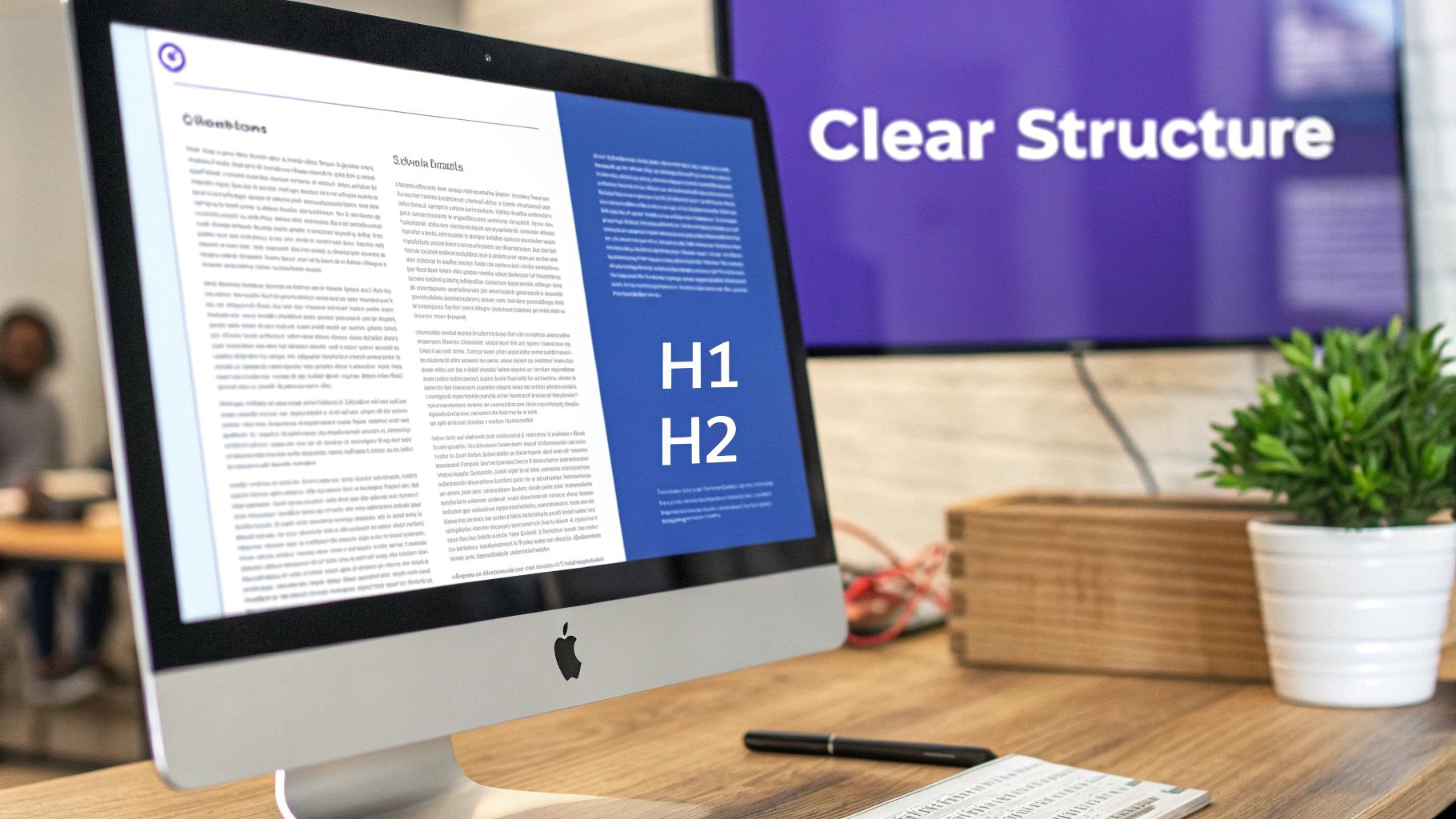
Your headings (H1, H2, H3, etc.) are the most important signposts for an AI. They create a clear hierarchy that outlines your article’s main ideas and sub-points, helping an AI model see the relationships between different pieces of information.
Imagine you're writing about customer feedback. A logical structure might look like this:
- H1: The Complete Guide to Collecting SaaS Customer Feedback
- H2: Different Types of Customer Feedback
- H3: Collecting Active Feedback with Surveys
- H3: Gathering Passive Feedback from Analytics
- H2: Tools for Effective Feedback Collection
This simple organization tells the AI exactly what each section covers and how it fits into the bigger picture. It’s a clean outline that makes your content easy to digest. Of course, writing good survey questions is a huge part of this, and there's a lot to learn about essential survey design best practices that can help.
Implement Structured Data with Schema Markup
Structured data, or Schema markup, is code you add to your site to explicitly tell search engines and AI models what your content is about. It's like adding little labels to your information so machines don't have to guess. This is a powerful tactic for making your content more machine-readable.
For a SaaS business, you can use Schema to define specific elements of your product or content.
By using Schema, you're spoon-feeding the AI exactly what it needs to know. You're not hoping it figures out that a "churn deflection flow" is a software feature; you're explicitly telling it. This clarity dramatically increases the chance of an accurate citation.
Here are a few practical examples for a company like Surva.ai:
- SoftwareApplication Schema: Use this to define your product. You can specify its name, features, and pricing. You could label "testimonial collection" as a specific
featureListitem. - HowTo Schema: If you have a tutorial on setting up a survey, this Schema type breaks down each step for the AI. This makes it incredibly easy for ChatGPT to pull your instructions into a step-by-step answer.
- FAQPage Schema: Marking up your frequently asked questions helps AI models find direct answers to common user queries, making your content a prime source for quick, factual responses.
Implementing structured data removes ambiguity and gives the AI confidence in your information.
Write in Simple Language and Formats
Complex sentences and fancy layouts might look great to a human reader, but they can confuse AI crawlers. These models perform best when they can parse simple, direct language.
Keep your sentences and paragraphs short. Use clear, straightforward vocabulary. If you want to learn more, you can explore the details of semantic analysis and AI language understanding.
Also, think about your page layout. Heavy use of images, complex tables, or interactive elements can sometimes prevent crawlers from accessing the text. It’s a good practice to make sure the core information is in simple HTML. The goal is to present your key points in a way that requires zero interpretation.
By combining a clean heading structure, specific Schema markup, and simple language, you make it incredibly easy for an AI to see your content as a reliable and citable source.
Building Authority to Become a Trusted AI Source
AI models, at their core, are designed to find and prioritize information from sources they deem trustworthy. So, if you want your content cited by ChatGPT, your brand needs to be seen as an authority in your field. This is not something that happens overnight; it’s built through a steady mix of high-quality backlinks, positive mentions on respected sites, and a solid overall domain reputation.
For SaaS companies, one of the most direct paths to building this kind of credibility is to target the very publications that AI models already trust and frequently cite. Getting your tool reviewed or featured on these platforms can give you a massive advantage.
Get Featured on High-Authority Tech Sites
Ever notice how often ChatGPT leans on major tech publications for its answers? There's a good reason for that. Sites like TechRadar, CNET, and PCMag have spent years cultivating a reputation for credible, in-depth reviews and analysis. AI models recognize this history and, as a result, give their content more weight.
Take a look at TechRadar's homepage; it's a perfect example of a site that AI models frequently use as a source.
The site is packed with reviews, comparisons, and "best of" lists, all structured to deliver clear, factual information. This is exactly what an AI model is looking for.
The strategy here is pretty straightforward: get your SaaS product on their radar. This could mean reaching out to editors with a compelling pitch, offering them a full demo of your platform, or showing them a unique feature that solves a common pain point. A single positive review or even just an inclusion in a "best feedback tools" roundup can have a lasting impact on your visibility in AI-generated answers.
A 2024 analysis confirmed this, finding that the top 50 domains captured nearly 48% of all ChatGPT citations, with tech review sites leading the pack. This data points to a clear opportunity for SaaS businesses that can successfully get in front of these high-authority platforms or build similar credibility in their own niche. You can dig into the specifics in the full ChatGPT citations report.
Create Original, Data-Backed Reports
Another powerful way to build authority is to become the source of the data itself. Instead of just commenting on industry trends, why not create them? Publishing original, data-backed reports positions your brand as a genuine thought leader and naturally attracts the kind of high-quality backlinks that both search engines and AI models love.
Think about the unique data your SaaS company already has access to. If you run a survey tool like Surva.ai, you could analyze thousands of anonymous survey responses to uncover fresh insights about customer churn or feedback trends.
Here’s a practical way to approach it:
- Find a Gap: What questions are people in your industry asking that nobody has answered with hard data?
- Use Your Data: Analyze your own platform's anonymous, aggregated data to find interesting patterns. For instance, you could report on the most common reasons customers give for canceling a SaaS subscription.
- Publish and Promote: Turn your findings into a comprehensive report, complete with sharp-looking charts and clear takeaways. Then, get it in front of industry journalists, bloggers, and influencers.
When other sites cite your report as the primary source for a statistic, you gain a highly valuable backlink. Over time, these links signal to AI models that you are a credible and authoritative voice in your space.
The goal is to make your brand synonymous with reliable data in your niche. When an AI needs a fact or statistic about customer feedback, you want your report to be the definitive source it pulls from. This is how you move from being part of the conversation to leading it.
This strategy definitely requires some effort, but the payoff is substantial. Original research not only helps you get cited in ChatGPT but also strengthens your overall SEO and brand reputation.
Collect and Display Customer Testimonials
Authority is not just about what other publications say about you; it’s also about what your customers are saying. Testimonials and reviews are powerful signals of trust, both for humans and for AI.
AI models can crawl and parse the reviews and testimonials on your website to gauge your product's credibility and user satisfaction. Having a dedicated page filled with positive feedback from real customers provides tangible proof that your tool delivers on its promises.
Make testimonial collection a systematic part of your customer lifecycle. For instance, using a tool like Surva.ai, you could trigger a feedback survey right after a customer has a positive interaction or hits a key milestone in your product. That's the perfect time to ask for a testimonial.
Displaying this social proof prominently on your site is just as important. You can find some excellent inspiration in these social proof examples to see how to present testimonials effectively. By showcasing genuine user feedback, you build a stronger case for your authority and make your site a much more trustworthy source for AI models to reference.
Capitalizing on Live Web Browsing
Modern AI models are no longer stuck in the past, limited to the data they were trained on years ago. With live web browsing, tools like ChatGPT can pull fresh, up-to-the-minute information to answer user questions. This is a massive opportunity for you to get cited in ChatGPT, as long as your content is timely and relevant.
The whole strategy hinges on the AI's integration with search engines like Bing. When a user asks about a recent event or a topic that needs the latest data, ChatGPT can perform a live search. It then synthesizes what it finds into an answer, often citing its sources. This is exactly where your SaaS content can step into the spotlight.

This direct access to the live web is a game-changer. It means the timeliness of your content is more important than ever.
The Power of Recency
When an AI browses the web, it’s on the hunt for the most current and authoritative information it can find. A blog post from last week covering "new AI-powered survey techniques" is far more likely to get picked up than a static, two-year-old page on the same subject. Recency is a powerful signal of relevance.
This is not just a hunch; the data backs it up. An analysis from Ahrefs shows just how important being up-to-date is for getting citations. High-traffic pages, like TechRadar's laptop buying guide or Tom's Guide's piece on web hosting, rack up thousands of citations partly because they are constantly refreshed with the latest info. For SaaS content to stay on an AI's radar, it needs to be kept fresh. You can dig into the specifics in Ahrefs' research on ChatGPT's most cited pages.
So, what does this mean for your content strategy?
- Keep Your Cornerstone Content Evergreen: Pinpoint your most important articles and guides. Schedule regular reviews to update stats, add new examples, and toss out any outdated information.
- Publish Timely, Relevant Articles: Keep a close eye on industry trends and news. By publishing content that speaks to current conversations, you position yourself as a go-to source for the latest insights.
- Add "Last Updated" Dates: This is a simple but super effective signal to both users and AI crawlers that your information is current.
Think of your content calendar as a living document. It is not just about pushing out new stuff; it’s about maintaining the value and accuracy of what you’ve already built. That continuous effort is what gets you noticed in a live web search.
Making Your Latest Content Easy to Find
Beyond just updating your pages, you need to make it dead simple for AI tools and plugins to discover your new content the moment it goes live. This is where a bit of tech know-how comes in, specifically with RSS feeds and APIs. Many third-party plugins that feed information into ChatGPT rely on these to pull in fresh data.
An RSS (Really Simple Syndication) feed is a standardized format used to publish frequently updated content, like blog posts or news headlines. By maintaining a clean and accessible RSS feed, you create a direct pipeline for your latest content to be syndicated across all sorts of platforms and tools that AI models might be using.
Likewise, an API (Application Programming Interface) lets different software applications talk to each other. If your company offers a public API that exposes your latest content or data, you're giving developers and AI tools a structured way to access your information directly. This is a more advanced play but can be incredibly effective, especially for data-heavy SaaS businesses. For more ideas on integrating tech without a ton of coding, you might be interested in checking out the top no-code AI platforms.
By prioritizing recency and making your updates easy to grab through feeds and APIs, you’re setting your content up to be a top choice for AI models browsing the live web. This proactive approach is fundamental to any strategy aimed at getting cited in ChatGPT.
Frequently Asked Questions About AI Citations
As you start optimizing your content for LLMs, a few practical questions are bound to pop up. Let's tackle some of the most common ones we hear from SaaS teams diving into these strategies.
How Long Does It Take to Get Cited by ChatGPT?
This is the million-dollar question, but unfortunately, there's no magic number. Seeing your content appear in an AI response is not an overnight thing; it depends on a mix of factors like how often crawlers hit your site, your existing domain authority, and how much buzz there is around your topics.
Think of it more like SEO than a quick marketing win. Your chances improve over weeks and months as you consistently put out high-quality, well-structured content and build up your site's reputation. Persistence is the name of the game here.
Does Site Authority Really Matter for LLMs?
Yes, it matters a lot. Just like traditional search engines, language models look for signals of trustworthiness, and things like backlinks and brand mentions from reputable sources are huge indicators. A higher authority basically tells the model that your content is credible and can be relied on.
Building your site’s authority is a core part of getting cited. An AI is far more likely to trust and reference a source that is already well-regarded within its industry. This makes authority-building activities more important than ever.
And if you're curious about whether your efforts are paying off, it's a good idea to monitor ChatGPT brand mentions. This gives you a clear picture of what’s working so you can double down on it.
New Content vs. Updating Old Content?
So, where should you focus your energy: creating brand-new articles or refreshing your existing ones? Honestly, you need to do both. Each strategy plays a unique and important role.
- Creating new content helps you stake your claim as a thought leader, especially if you're publishing original research or data-driven reports. This is the kind of stuff that naturally attracts backlinks and gets you known as the go-to source for new insights.
- Updating old content is all about staying current. By regularly refreshing your best articles with the latest data, stats, and examples, you're making them far more appealing for an AI to pull from during a live web search.
A balanced approach is best. You will be building new authority while also keeping your foundational content relevant and primed for AI models.
Can Niche SaaS Companies Get Cited?
Absolutely. In fact, being in a tight niche can be a massive advantage. It gives you the chance to become the single most comprehensive and authoritative voice on a very specific subject.
Think about it: when you create the best, most in-depth content in a small field, you make the AI's job easy. A user asks a question about your area of expertise, and your site becomes the most logical and reliable place for the model to pull its answer from. It's a fantastic way for smaller, specialized companies to punch above their weight.
Ready to turn customer feedback into your biggest growth driver? Surva.ai gives SaaS teams the tools to reduce churn, collect powerful testimonials, and build a product that customers love. Start making data-driven decisions today. Learn more at https://www.surva.ai.

Sophie Moore
Sophie is a SaaS content strategist and product marketing writer with a passion for customer experience, retention, and growth. At Surva.ai, she writes about smart feedback, AI-driven surveys, and how SaaS teams can turn insights into impact.