
Tools to Track Brand Mentions Across AI Platforms: Look Beyond One Visibility Score
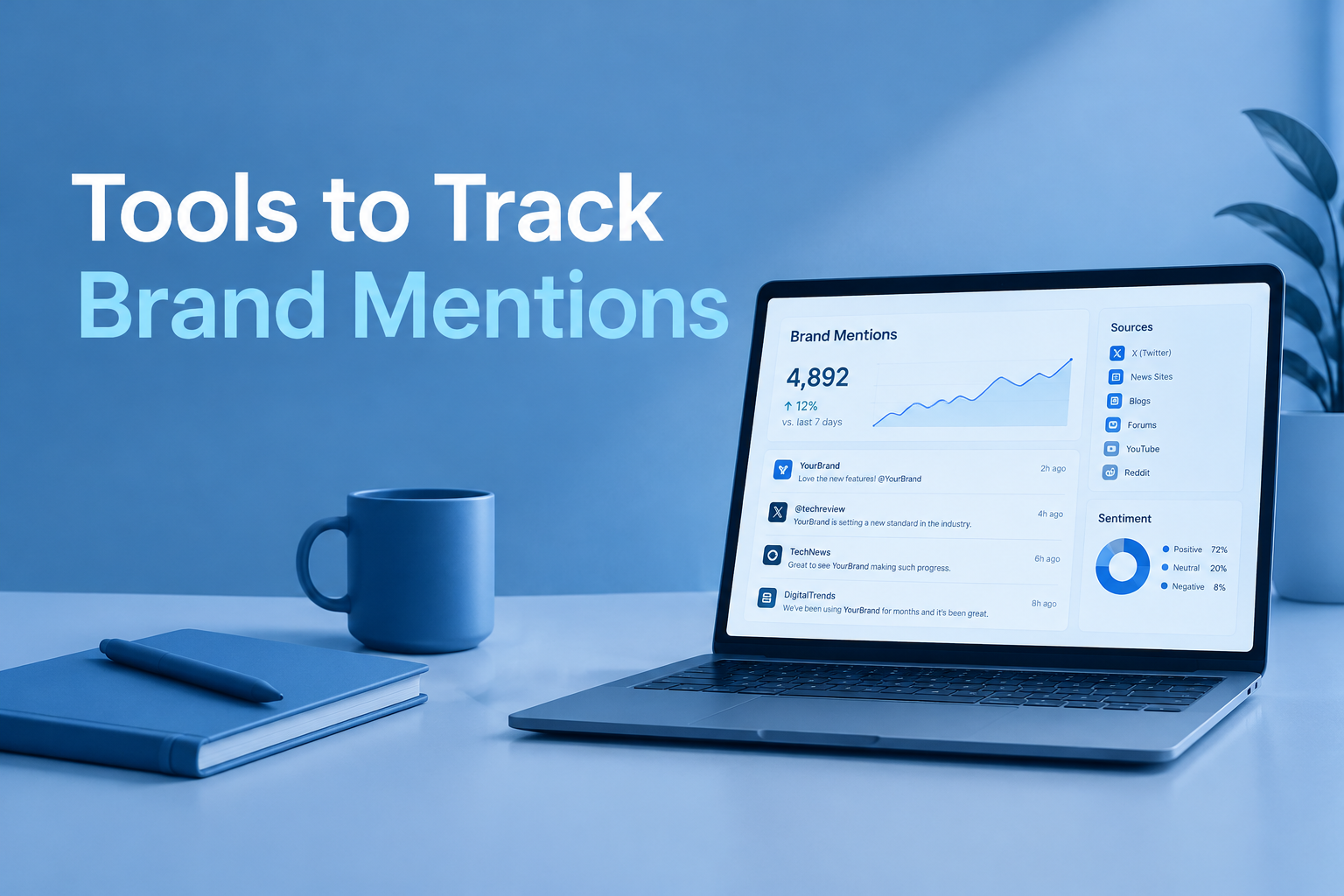
Tools to track brand mentions across AI platforms include Surva.ai, Peec AI, Otterly.AI, Profound, Semrush AI Visibility Toolkit and Ahrefs Brand Radar. These tools help you monitor AI answers, compare competitors and investigate the sources behind the results. Their platform coverage, collection methods and reporting differ, so compare the exact features included in your plan.
As a marketing, the important question is "Which buyer questions mention us, on which platforms, with which sources, and how consistently?"
This guide compares the options for monitoring how your brand shows up in the leading AI models and explains how to track ChatGPT, Perplexity, Claude, Gemini and Google AI Overviews without mistaking one dashboard number for your entire market presence.

Which tools track brand mentions across AI platforms?
Start with your workflow: monitoring a fixed set of buyer questions, researching a broader market, or getting help acting on the findings.
| Tool | A useful fit for | What to evaluate | Important buying check |
|---|---|---|---|
| Surva.ai | Small businesses and marketing teams that want tracking connected to content work, with an optional managed service | Brand mentions, cited URLs, competitor gaps and content workflows across ChatGPT, Perplexity, Claude, Gemini and AI Overviews | Confirm collection methods, refresh frequency and the division of work between your team and the managed service |
| Peec AI | Marketing teams focused on AI search analytics | Prompt monitoring, brand comparisons and source analysis | Check the models included in your chosen plan |
| Otterly.AI | Teams comparing dedicated AI monitoring and content optimization options | Brand mentions and website citations across several AI search platforms | Confirm engine add-ons and how each engine is collected |
| Profound | Organizations evaluating a broader AI marketing workflow | Answer Engine Insights, prompt research and tools for turning findings into marketing work | Confirm the scope, integrations and coverage in your proposal |
| Semrush AI Visibility Toolkit | SEO teams that want AI tracking alongside existing search reporting | Custom prompt tracking, competitor comparisons and cited-source reports | Verify coverage for the specific report you need |
| Ahrefs Brand Radar | Teams that want both broad market research and a custom prompt benchmark | An AI visibility index plus tracking for questions you define | Distinguish index access from custom prompt checks, including how checks are consumed |
Surva.ai: tracking with a path to action
Surva.ai tracks brand mentions and citations across ChatGPT, Perplexity, Claude, Gemini and Google AI Overviews. Its citation tracking includes saved responses, cited URLs and competitor citation analysis, so you can inspect the evidence behind a result.
It also connects monitoring to content planning and publishing workflows. That makes it worth considering if your main challenge is turning a visibility report into work someone will actually complete.
You can run the platform yourself or use the managed AI visibility service. The managed service covers setup, monitoring, analysis and a monthly plan with content briefs. Your team still needs to publish or arrange publication of the recommended content.
Self-serve pricing starts at $49 per month on monthly billing. The managed service is $399 per month with a three-month minimum, as reviewed in October 2026. Check current pricing and scope before purchasing.
Peec AI: focused AI search analytics
Peec AI focuses on AI search analytics for marketing teams. Compare it if you want to organize prompts, benchmark brands and investigate the sources appearing in AI answers.
Its pricing page specifies model allowances, so check your required engines against the plan you select. A vendor supporting several platforms does not necessarily mean every platform is included in every subscription.
Otterly.AI: dedicated monitoring and content optimization
Otterly.AI advertises monitoring across ChatGPT, Perplexity, Google AI Overviews, AI Mode, Gemini, Copilot and Claude, alongside content optimization features.
Ask which engines are included, which require add-ons and whether each result comes from a consumer interface or an API. Its website distinguishes Claude API in its interface, which is the kind of collection detail worth checking before comparing results.
Profound: a broader AI marketing workflow
Profound combines answer-engine analysis with a broader AI marketing platform.
It is worth evaluating when monitoring is one part of a larger research, content and brand workflow. Compare the deliverables and operating requirements of the package you would actually buy, including integrations and how your team will use the findings.
Semrush: AI tracking alongside SEO reporting
Semrush’s Prompt Tracking documentation describes daily monitoring of custom prompts, competitor comparisons and source reporting, including ChatGPT Search, Google AI Mode and Gemini.
For teams already using Semrush, keeping AI and traditional search reporting together may simplify the workflow. Check current support for your required platform in the exact module you plan to use, because coverage can differ between reports.
Ahrefs Brand Radar: market research and custom prompts
Ahrefs Brand Radar distinguishes its broad AI Visibility Index from custom prompt tracking.
Those answer different questions. The index helps explore a market, while custom prompts let you follow a consistent benchmark of questions relevant to your business.
Do not compare their percentages as though they came from the same sample. Check which data source a report uses and how its prompt checks are counted.
What should an AI brand mention tracker measure?
A mention is a brand name in an answer. A citation is a source link. A recommendation is an endorsement for a particular need. These can happen together, but they are not interchangeable.
| Measurement | Example | What to inspect |
|---|---|---|
| Brand mention | An answer names Social Intents | Is the brand relevant to the question, and is its description accurate? |
| Owned-site citation | The answer links to a Social Intents product page | Which URL is linked, and what claim does it support? |
| Third-party source about the brand | The answer cites a comparison page that discusses Social Intents | Does that page describe the product correctly? |
| Recommendation | The answer suggests Social Intents for a team using Microsoft Teams | Is the recommendation positive, conditional or accompanied by a warning? |
| Referral or conversion | Someone follows a source link and signs up | Does the visibility lead to a measurable business outcome? |
A mention without a link does not prove the model learned your brand from training data. It also does not prove that your website is untrusted. The saved answer shows what the system returned, not every reason it selected those words.
Likewise, a source link does not automatically mean the answer recommends the brand. Read the surrounding text.
Why a single AI visibility score is not enough
A summary score can be useful for a quick check. It becomes misleading when you cannot see what changed underneath it.
Imagine this illustrative report, with 100 valid answer samples per platform:
| Platform | Answers mentioning the brand | Mention rate |
|---|---|---|
| ChatGPT | 60 of 100 | 60% |
| Perplexity | 10 of 100 | 10% |
| Claude | 20 of 100 | 20% |
| Gemini | 30 of 100 | 30% |
The pooled mention rate is 30%. That number hides a strong ChatGPT result and a much weaker Perplexity result. It also says nothing about whether these were branded questions, category recommendations or product comparisons.
Use summary scores to notice changes. Use the underlying prompts, responses and sources to decide what to do. Apply that standard to Surva.ai as well as any other tool.
Define what your percentages measure
For a fixed prompt set, a simple mention-rate calculation is:
Brand mention rate = valid answer samples naming your brand ÷ all valid answer samples × 100.
Count a brand once per answer, even if its name appears several times. Record failed requests separately, rather than counting them as answers that omitted the brand.
For an owned-site citation rate, count valid answers that link to at least one of your pages.
A share-of-voice metric needs its own definition. Specify the competitor set and whether it counts answers, mentions, links or weighted positions. Two tools can use the same metric name while calculating it differently.
Handle Google AI Overviews separately
Google AI Overviews do not appear for every search. Google’s documentation also distinguishes AI Overviews from AI Mode; they can use different models and show different responses and links.
Record these outcomes separately:
- An AI Overview appeared and mentioned your brand.
- An AI Overview appeared without your brand.
- No AI Overview appeared.
- The collection attempt failed.
Report both the percentage of successful checks that triggered an Overview and your mention rate among the Overviews that appeared.
If you also report appearances across all successful searches, label that denominator explicitly. Otherwise, a change in how often Google displays an Overview can look like a change in your brand’s performance.
How to track brand mentions across AI platforms
1. Build a small benchmark around buying decisions
Start with 20 to 30 priority prompts. This is a practical starting point, not a scientifically established minimum. Use sales questions, customer conversations and search-query data to choose the wording.
For a live chat product, a starter set might include:
| Prompt type | Example | Purpose |
|---|---|---|
| Category discovery | What are the best live chat tools for small businesses? | Test whether the brand enters a general shortlist |
| Integration need | Which live chat tools let agents respond from Microsoft Teams? | Test a specific product fit |
| Problem-led | How can a small support team answer website questions after hours? | Test discovery through a customer problem |
| Comparison | Social Intents vs Tidio for a team using Slack | Inspect competitive positioning |
| Branded accuracy | Does Social Intents support Google Chat? | Check whether product facts are correct |
Keep most discovery prompts unbranded. Asking about your product by name is useful for accuracy checks, but it is not evidence that AI would introduce you to a buyer who did not know you existed.
Report branded and unbranded results separately. Save the original wording and version any changes.
2. Choose platforms and record the collection settings
Specify the platform, search mode, country, language, date and collection method wherever available.
Do not treat a Gemini answer as a Google AI Overview, or an API response as an exact reproduction of a consumer session.
API monitoring can provide a useful repeatable benchmark. Consumer-interface checks can provide another perspective. Both need clear labels, and neither captures every personalized conversation a customer might have.
3. Save answers, not just percentages
For each check, retain:
- The exact prompt and timestamp.
- The platform and available collection settings.
- The answer text.
- Brand mentions and named competitors.
- Cited URLs.
- A status field for missing or failed results.
Spot-check automated brand matching. A generic company name, a reseller or a similarly named product can otherwise create false positives.
The ability to open a saved answer is also useful when AI describes your pricing, integrations or capabilities incorrectly.
4. Repeat checks before declaring a trend
Run your priority prompts repeatedly over an initial two-week period if budget allows. Daily checks can help establish a starting view; a smaller weekly benchmark can still be useful if its limitations are clear.
There is no universal number of runs that makes AI visibility statistically reliable. A week or two of data is an initial baseline, not a permanent noise threshold.
Compare equal-length periods with the same prompt set and collection settings. Investigate changes that persist across several checks. Record model changes and collection interruptions alongside your own content updates.
5. Find the specific gap
When a competitor appears and you do not, inspect the answer and its sources:
- Does the answer misunderstand your product or its integrations?
- Does it cite a comparison page that excludes your brand?
- Is an outdated third-party page supplying incorrect information?
- Does your website lack a clear page answering the buyer’s question?
- Are relevant pages unavailable to crawlers or difficult to find through internal links?
These are hypotheses to investigate. A cited comparison page is a useful lead, not proof that inclusion on that page will produce a recommendation.
The same applies to your own content. If AI repeatedly cites a competitor’s integration guide, compare what that guide explains with what your page provides.
6. Make one focused change and measure again
Update the page that answers the question, correct inaccurate product information or pitch a relevant editorial comparison with verifiable facts. Record what changed and when.
Then rerun the same benchmark.
Look for sustained changes in mentions, citations and recommendation wording, alongside referral traffic and conversions. A visibility increase after an edit is evidence of an association, not proof that the edit caused it.
What to ask before choosing a tracking tool
Ask each vendor to demonstrate one of your own prompts and trace the result back to its saved answer.
- Which platforms and search modes are included in this plan?
- How is each platform collected, and how does that differ from a consumer session?
- Can we supply our own prompts and keep a stable benchmark?
- How often are prompts checked, and can we see the sample counts?
- Can we inspect full answers and exact cited URLs?
- Are brand mentions, owned-site citations and recommendations distinguishable?
- How are competitors, brand aliases and ambiguous names handled?
- Are location, language and collection failures visible?
- Can we export results and retain enough history for comparisons?
- What work does the platform or service help us complete after finding a gap?
Compare costs using the same workload. Thirty prompts across five platforms represent 150 checks per run before repetitions or additional locations. Vendors may package those checks differently.
Also decide who will own the work. A detailed dashboard is less useful if nobody reviews it or acts on the findings.
When a spreadsheet is enough
A spreadsheet can work if you have a handful of high-priority prompts and someone who will review them consistently. Record the same fields you would expect from a paid tracker, including full answers and sources.
For example, five prompts across three platforms produce 15 checks per review. Add repeated runs, competitors and multiple markets, and manual work grows quickly.
Paid monitoring becomes useful when consistency, history and review time matter more than the subscription cost.
Even if your brand has few mentions, competitor answers and cited sources can help identify where to start. A zero mention rate is not automatically a reason to stop measuring.
How to turn tracking into better source material
Choose one important buyer question and make the relevant page easier to understand, verify and cite:
- Answer the question directly near the beginning. Give readers a useful answer before introducing background.
- Describe the product and intended customer in specific terms. Include relevant capabilities and limitations.
- Use comparison tables where they clarify real differences. Avoid declaring every feature a win for your own product.
- Link factual claims to primary sources. Product documentation is usually more useful than an unsourced roundup.
- Add original evidence. Documented tests, screenshots with context and clearly scoped case studies give readers something they cannot find in every competing article.
- Keep product information current. Outdated prices and integrations weaken an otherwise useful page.
- Make important information available as readable page text. Do not leave the main comparison or explanation only inside an image.
Google says its established SEO practices remain relevant to AI Overviews and AI Mode, with no special optimization required for inclusion. Its AI features guidance is a better starting point than promises that a particular schema or formatting trick guarantees citations.
For Surva.ai users, begin with prompt tracking, inspect the citation sources, then choose the page or external listing that needs work.
If nobody on your team owns the process, the managed AI visibility service can handle monitoring and turn the findings into a monthly plan.
The goal is a repeatable process: identify a buyer question, inspect the evidence, improve the relevant information and measure again.
Frequently asked questions
What are tools to track brand mentions across AI platforms?
Options include Surva.ai, Peec AI, Otterly.AI, Profound, Semrush AI Visibility Toolkit and Ahrefs Brand Radar. Compare their supported engines, collection methods, custom prompt controls, source reporting and workflow features. A platform logo alone does not tell you what is included in a particular plan.
Can Surva.ai track ChatGPT, Perplexity, Claude and Google AI Overviews?
Yes. Surva.ai supports those platforms along with Gemini. Its prompt and citation tracking help you review brand appearances, saved answers and cited sources. Use those results as a benchmark of collected answers, not a count of every customer conversation.
What is the difference between a brand mention and an AI citation?
A brand mention names a company or product in an answer. An AI citation links to a source page. An answer can mention your brand while citing another website, or cite your website without recommending your product.
Can I track AI brand mentions for free?
You can manually check a small prompt set and record the results in a spreadsheet, subject to each platform’s access limits. Keep the questions and settings consistent, save the answers and repeat the checks. The main cost is your time.
Does a higher visibility score mean more customers saw my brand?
Not necessarily. A tracker usually measures a defined sample of answers, not total audience exposure. Review the underlying prompt set and sample counts, then measure referrals, leads and conversions separately.
Can any tool guarantee AI mentions or citations?
No tool can guarantee that an external AI platform will recommend your business or cite a particular page. Tracking helps you identify gaps and evaluate changes; source selection remains outside the tracker’s control.
Share this article